
Every October, the Armenian Church celebrates the Feast of the Holy Translators: a celebration deeply rooted in the spiritual, cultural and intellectual history of the Armenian people. It is a month in which we remember not only the great translators who brought the Holy Scriptures and the writings of the Church Fathers into Armenian, but also the creation of the Armenian alphabet and the extraordinary cultural awakening that followed.
For Armenians, the story of the Holy Translators is much more than a chapter in history. It is a story of faith, identity, language, education and gratitude.
The Armenian Alphabet: A Gift to a People
At the beginning of the fifth century, Armenia faced an important challenge. Christianity had become the faith of the Armenian people, but the Scriptures and much of the Christian literature were not yet available in the Armenian language. The Armenian people needed a written language through which they could express their faith, educate their children and preserve their cultural identity.
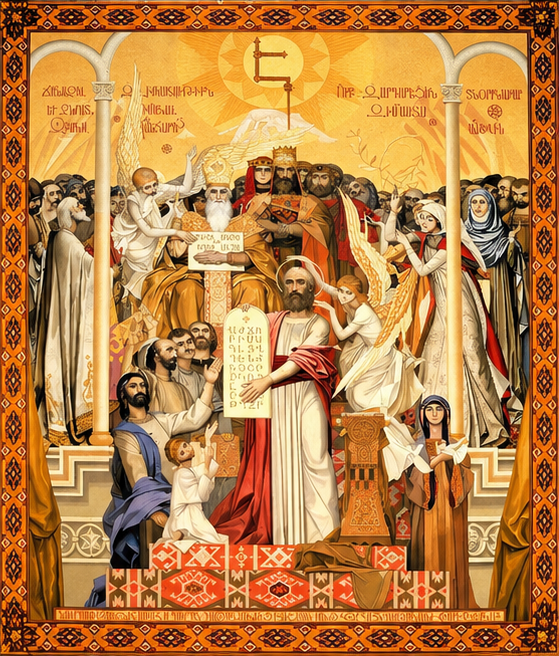
In this historical context, St. Mesrop Mashtots, with the support of St. Sahak Catholicos, created the Armenian alphabet around 405. They had the support of King Vramshabouh.
Creating the alphabet was a turning point in Armenian history. The Armenian language could now serve as a vehicle for worship, education, literature, theology, and historical writing. The alphabet was not simply a collection of letters; it became an instrument through which an entire people could preserve and transmit its spiritual and cultural heritage.
Soon after the creation of the alphabet, the Holy Scriptures were translated into Armenian. The work traditionally associated with this extraordinary generation of scholars and clergy became the foundation of what Armenians call the Golden Age (Ոսկեդար) of Armenian literature.
The Holy Translators and the Golden Age
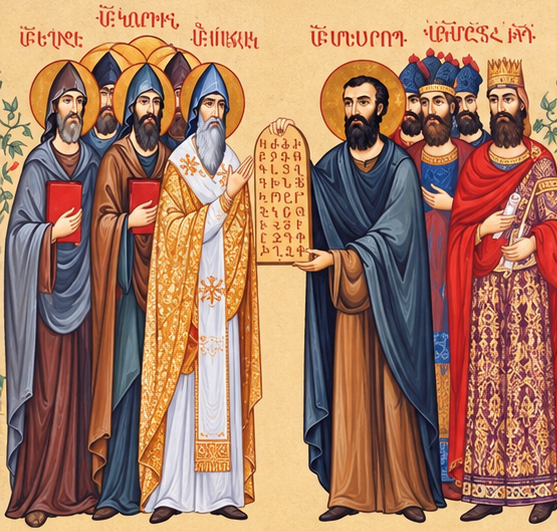
The fifth century became one of the most remarkable periods in Armenian intellectual and spiritual history. St. Mesrop Mashtots, St. Sahak Partev, St. Yeznik of Kolb, St. Koriun, St. Movses Khorenatsi and many other scholars and disciples contributed to an extraordinary movement of translation and literary creation.
Their work was not limited to translating words from one language into another. They sought to communicate the meaning, theology and spiritual depth of the Christian tradition in a language that the Armenian people could understand and make their own.
The translation of the Bible was at the heart of this movement. The Armenian translation became so renowned for its beauty and faithfulness that it has traditionally been called the “Queen of Translations.”
The translators also brought into Armenian many important theological, philosophical and literary works from Greek, Syriac and other languages. Through their efforts, Armenian readers gained access to the writings of the great teachers of the Christian Church.
Translating the Church Fathers
One of the greatest achievements of the fifth-century translators was the translation of the works of the Church Fathers.
The writings of early Christian theologians and teachers contained profound reflections on Scripture, Christian doctrine, spiritual life, morality and the nature of the Church. By translating these works into Armenian, the Holy Translators made the intellectual and spiritual treasures of Christianity accessible to the Armenian people.
Their work also helped establish Armenian as a language capable of expressing sophisticated theological and philosophical ideas.
The Armenian Church therefore became not merely a community that received Christian teaching, but a community that studied, preserved and developed that teaching in its own language.
Some translated works have an importance extending beyond Armenian history. There are writings of ancient authors that have survived, in whole or in part, through Armenian translations when the original Greek or Syriac texts were later lost. Thus, the Armenian translators became guardians not only of Armenian heritage but also of the wider intellectual heritage of Christianity and the ancient world.
Why Do We Celebrate the Holy Translators?
We celebrate the Holy Translators because their work continues to shape who we are.
We celebrate them because they gave the Armenian people the means to read the Word of God in their own language.
We celebrate them because they established a literary tradition that has continued for more than sixteen centuries.
We celebrate them because they understood that faith must be taught, studied and lived, not merely inherited.
And we celebrate them because they recognized that preserving a language means preserving the memory, identity and spiritual heritage of a people.
The Feast of the Holy Translators therefore invites us to ask an important question: What are we doing today to preserve and transmit what we have received?
The Holy Translators received a precious heritage and made it accessible to the generations that followed. We, too, have received a precious heritage. It is now our responsibility to pass it on to our children and grandchildren.
The Meaning of the Celebration Today
For Armenians living in the diaspora, the message of the Holy Translators is particularly meaningful.
We live in societies where many languages and cultures meet. Our children may grow up speaking English, French or another language more fluently than Armenian. Yet the Armenian language remains one of the strongest bridges connecting generations.
When we teach our children Armenian, encourage them to read Armenian books, bring them to church, teach them our prayers and hymns, and share with them the history of our people, we continue the work of the Holy Translators.
In a sense, every generation becomes a translator.
We translate our heritage into the language and realities of a new generation. We explain the faith in ways our children can understand. We preserve traditions while helping them discover their meaning. We take what we have received from our ancestors and make it living and meaningful for those who will come after us.
From the Holy Translators to Thanksgiving
The celebration of the Holy Translators also leads naturally to another important theme: gratitude.
During this season, as we approach Thanksgiving, we are reminded to pause and recognize the blessings we have received.
The Holy Translators themselves left us a powerful example of gratitude expressed through service. They did not keep their knowledge for themselves. They used their gifts for the benefit of their people and for the glory of God.
As we gather with our families and friends around the Thanksgiving table, we can therefore remember another table—the spiritual table of our Armenian Christian heritage.
We can give thanks for the Armenian alphabet.
We can give thanks for our language.
We can give thanks for our Holy Scriptures and the rich spiritual heritage of the Armenian Church.
We can give thanks for the generations of clergy, teachers, scholars, writers and parents who preserved this heritage through difficult centuries.
And we can give thanks for the Holy Translators, whose dedication made it possible for Armenians to encounter the Christian faith through their own language.
Thanksgiving is not only about being grateful for what we possess. True gratitude also calls us to become responsible stewards of what we have received.
The Holy Translators received a gift and transformed it into a legacy.
May we do the same.
May we preserve the Armenian language, cherish our faith, teach our children, support our Church and transmit our heritage with love and dedication.
As we celebrate the Holy Translators this month and give thanks during this season, may we remember that the greatest expression of gratitude is not simply to say “thank you,” but to ensure that the gifts entrusted to us continue to live in the generations that follow.
May the legacy of St. Mesrop Mashtots, St. Sahak and the Holy Translators inspire us to become faithful guardians and grateful transmitters of our Armenian Christian heritage.